GitMCP
gitmcp.io- Good for
- Builders
- Category
- Development Tools
- Lets you
- Turn a GitHub repository URL into an MCP server URL
www.daytona.io
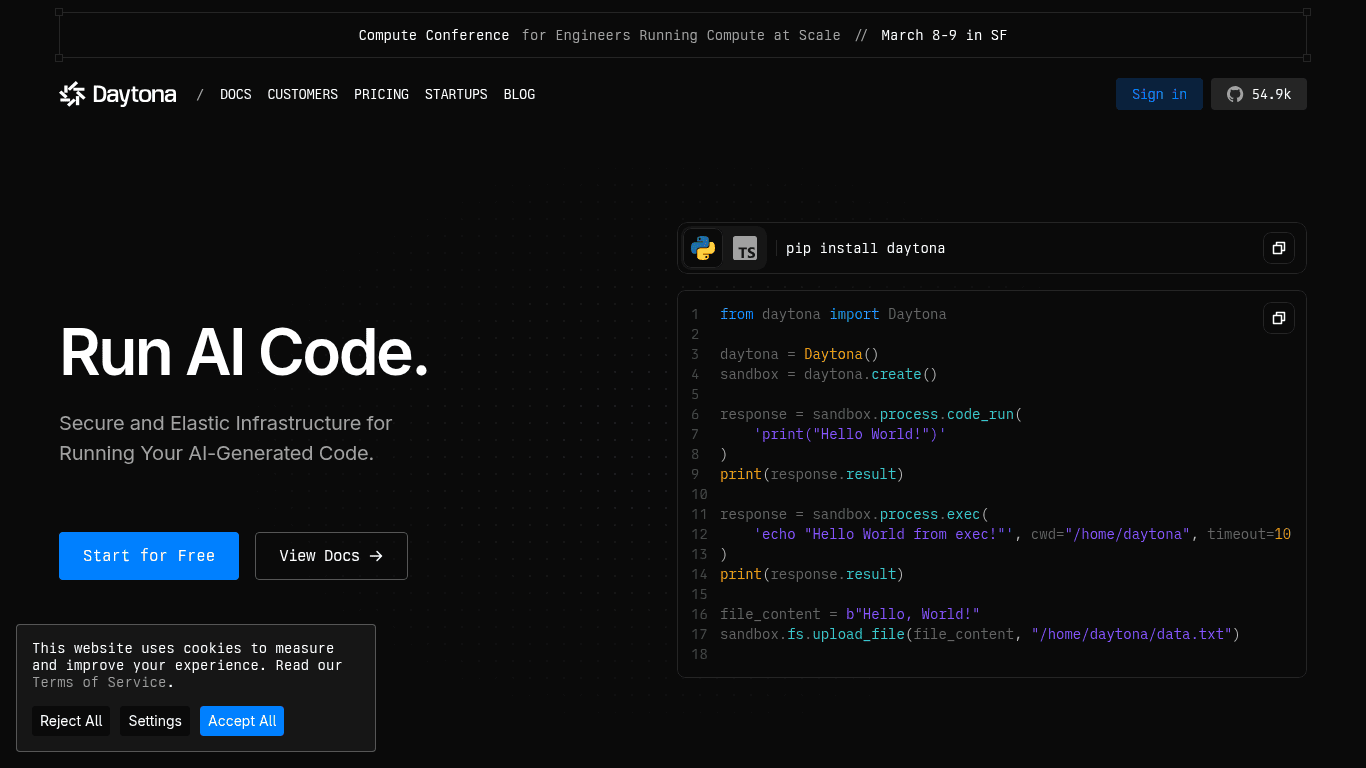
Daytona is an infrastructure platform for running AI-generated code in isolated sandbox environments. It provides programmatic APIs for executing commands, managing files, integrating with Git, and deploying virtual desktops.
Visit website (opens in a new tab)Daytona provides a secure and efficient infrastructure designed specifically for running AI-generated code. It focuses on delivering a fast, scalable environment that can ensure the safe execution of various code with an emphasis on ease of deployment and robust security.
Daytona boasts rapid execution capabilities, with environment creation times as low as 90 milliseconds. This allows developers to initiate and run code in sandbox environments quickly, addressing the increasing demand for speed in AI application development.
The platform separates AI-generated code execution from the core infrastructure, ensuring that there is zero risk to the underlying systems. Daytona implements isolated runtime protection, allowing developers to execute untrusted code without threat.
Developers can manage long-running tasks with stateful operations. Daytona sandboxes run indefinitely, providing persistent environments that are ideal for applications requiring continuous interaction.
Daytona facilitates user engagement by offering:
The platform allows users to deploy secure virtual desktops (Linux, Windows, macOS) under programmatic control, enabling developers to run desktop automation and software development directly within its environment.
Daytona supports shared data across sandboxes without compromising isolation, thus allowing agents to collaborate efficiently on tasks that require shared resources.
Daytona is particularly useful for developers, AI researchers, and organizations looking for an efficient way to deploy AI code in a secure environment. The following groups can benefit significantly from leveraging Daytona's infrastructure:
Daytona's infrastructure ensures a high level of security and compliance. By providing transparency with open-source principles, developers can verify and understand every line of code being used. The system adheres to compliance standards like HIPAA and GDPR, making it suitable for sectors requiring stringent data protection measures.
Daytona has garnered praise from industry leaders for its performance and efficiency. For instance, executives from various companies have highlighted Daytona's impressive sandbox provisioning speeds and its ease of integration into existing development workflows. Customers frequently commend the platform for its support in overcoming limitations they previously faced with other sandbox solutions.
Daytona stands as a robust platform that effectively meets the needs of a rapidly evolving AI landscape. With its quick deployment, security-focused architecture, and user-friendly interfaces, Daytona is well-positioned to facilitate developers in running AI-generated code with confidence and efficiency. This makes it an attractive choice for teams keen on integrating advanced AI capabilities into their solutions without compromising on security or performance. The platform also supports embedding and testing AI agents in real-time operations, contributing to an overall enhancing ecosystem for AI-driven projects.
Ready to try it? Visit www.daytona.io (opens in a new tab)