Open WebUI
openwebui.com- Category
- Development Tools
- What it does
- Open WebUI is an extensible, self-hosted interface for AI applications that can run fully offline. It supports LLM runners such as Ollama and OpenAI-compatible APIs.
jan.ai
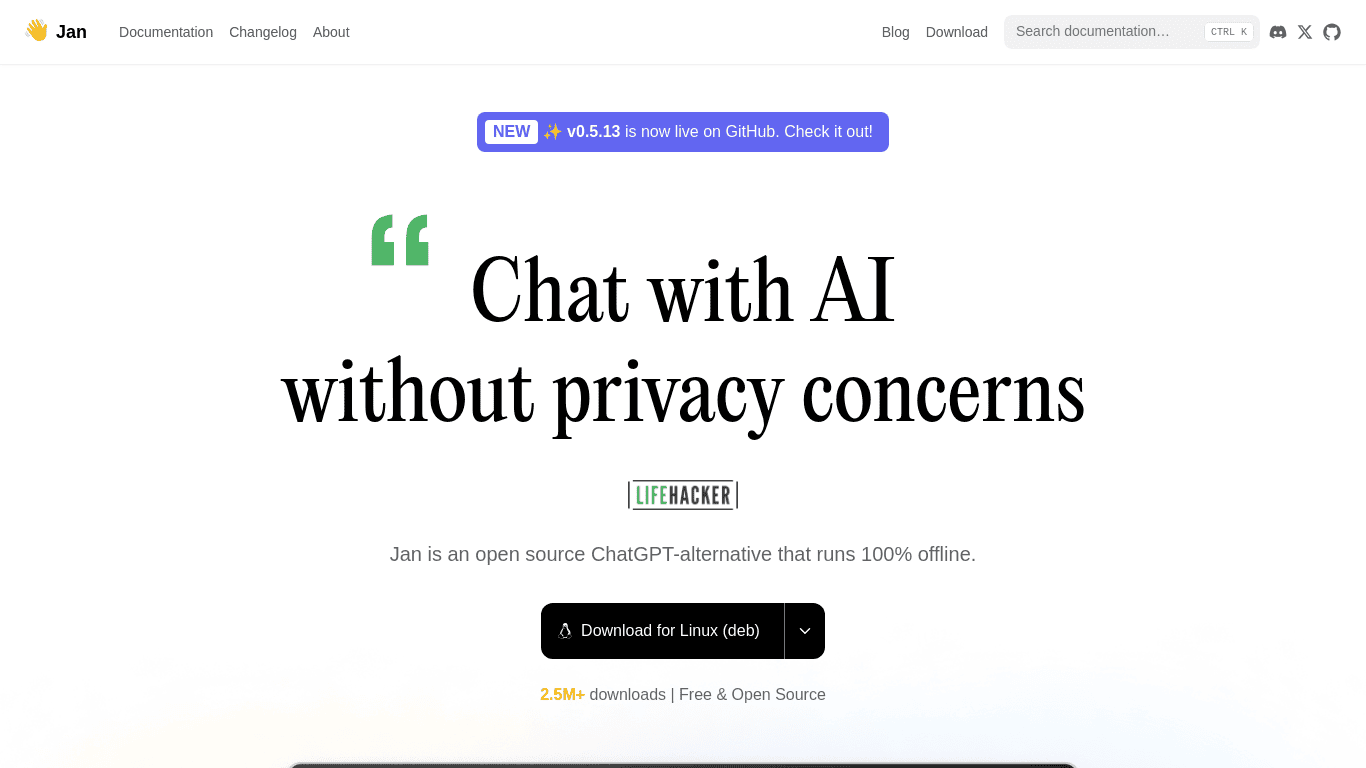
Jan is an open-source desktop application that runs AI language models locally for offline chat, with optional connections to cloud models. It includes a model hub, a local OpenAI-compatible API server and experimental chat with files.
Visit website (opens in a new tab)Jan is an innovative open-source alternative to ChatGPT that prioritizes user privacy by running entirely offline on local devices. With over 2.5 million downloads, it is a robust platform designed for users looking to engage with AI without the privacy concerns often associated with cloud-based solutions.
Jan is packed with useful features that enhance the user experience:
Users can interact with AI to ask questions, brainstorm ideas, and learn directly from the AI applications running on their devices.
The platform allows users to download and utilize powerful AI models such as Llama3, Gemma, and Mistral, directly from their computers.
In addition to local models, Jan provides the option to connect with more powerful cloud-based models when necessary. This feature supports accessing sophisticated capabilities while maintaining an offline backbone.
Jan enables users to set up and run their own OpenAI-compatible API server locally, facilitating easy interaction with models using just a single click.
As an experimental feature, Jan offers users the ability to engage in conversations with their files, enhancing productivity and data interaction.
Users can tailor Jan to better meet their preferences and requirements.
Coming soon, this feature will allow users to create personalized AI assistants that can remember past conversations and execute specific tasks across different applications.
Jan supports third-party extensions, enabling additional functionalities like cloud AI connectors and other tools to enhance the user experience.
Jan is built on a strong set of principles that dictate its development and usage:
Local-first: Jan ensures that conversations and files remain private by prioritizing local AI processing. This allows complete user control over their interactions with AI.
User-owned: The platform allows users to own their data, storing it in universal formats on their devices. This facilitates seamless data migration without hidden constraints.
Fully Customizable: Users can modify their experiences through customizable settings, including alignment, moderation, and censorship levels tailored to individual needs.
Jan thrives on community collaboration, with contributions from over 46 contributors and more than 2,800 pull requests to improve the platform. The project's transparency is evident from its 27,000 GitHub stars, reflecting strong community support and interest.
Jan is suitable for a diverse range of users including:
Jan is an essential tool for anyone interested in AI who values privacy and customization. By offering an offline alternative that is highly flexible and user-driven, it stands out as a significant innovation in the AI landscape. With its ongoing development and evolving features, Jan is set to remain a relevant and useful platform for diverse user groups in the foreseeable future.
Ready to try it? Visit jan.ai (opens in a new tab)