Semantica
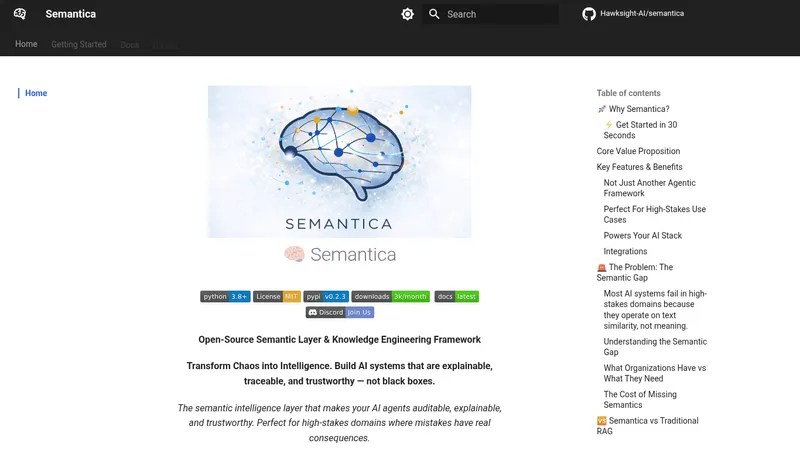
hawksight-ai.github.io- Good for
- Builders, Businesses
- Category
- Development Tools
- Lets you
- Extract entities and relationships from documents into a knowledge graph
zvec.org
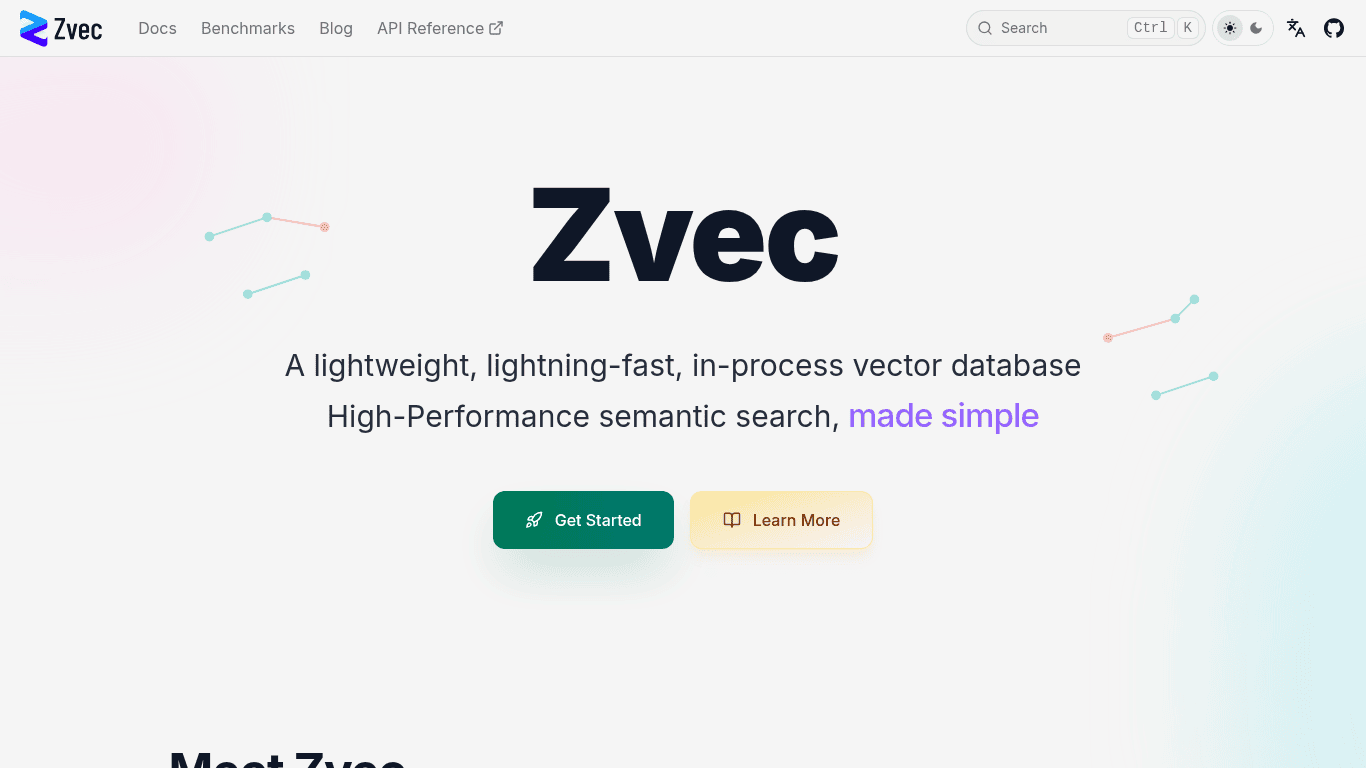
A lightweight vector database that runs inside your application for semantic search.
Visit website (opens in a new tab)Zvec is an innovative, lightweight vector database designed for high-performance semantic search applications. With its in-process architecture, Zvec enables developers to create powerful AI applications with minimum complexity while supporting advanced vector operations. The database ensures users can build semantic search functionalities seamlessly without the hassle of external services.
Zvec provides blazing-fast search capabilities that can efficiently handle billions of vectors. This rapid search capability is crucial for applications requiring real-time data retrieval and analysis.
The database places a strong emphasis on ease of use. Developers can get started in seconds with a straightforward installation process, allowing them to focus on their application logic rather than the underlying infrastructure.
Zvec accommodates both dense and sparse vector inputs, expanding its utility across various applications. Users can perform multi-vector queries, which allows for more complex data interactions and broader search capabilities.
The database combines semantic searches with filter functionalities, enabling users to refine search results based on specific criteria. This combination significantly enhances the precision of the results returned to users.
Zvec includes functionality to execute vector similarity searches with a "GROUP BY" style clause. This feature is particularly useful for aggregating and analyzing large sets of data categories, which can improve both search accuracy and efficiency.
One of the standout features of Zvec is its in-process design, which allows it to run directly within the user's application. This design choice eliminates the need for external services, offering greater performance and reducing latency.
Zvec features a user-friendly Python API that simplifies the database interaction process. Here are some code snippets illustrating basic operations:
Creating a Collection:
import zvec

schema = zvec.CollectionSchema(
    name="example",
    vectors=zvec.VectorSchema("embedding", zvec.DataType.VECTOR_FP32, 4),
)
collection = zvec.create_and_open(path="./zvec_example", schema=schema)
Inserting Data:
import zvec

collection = zvec.open("./zvec_example")
collection.insert(zvec.Doc(id="1", vectors={"embedding": [0.1, 0.2, 0.3, 0.4]}))
Querying Data:
import zvec

collection = zvec.open("./zvec_example")
results = collection.query(
    vectors=zvec.VectorQuery("embedding", vector=[0.4, 0.3, 0.3, 0.1]),
    topk=10,
)
These examples showcase the straightforward API that Zvec provides, allowing developers to execute fundamental operations with ease.
Zvec has been benchmarked against significant datasets, achieving impressive results:
These metrics illustrate Zvec's capacity to handle substantial data loads efficiently, making it suitable for applications requiring high throughput.
Zvec is tailored for various applications across different domains:
With Zvec, developers can enhance language model outputs by retrieving relevant information from a knowledge base. This capability is especially beneficial for applications in education, customer support, and content generation where contextual accuracy is essential.
The database can be utilized to find semantically or visually similar images. This feature is invaluable in fields such as e-commerce, where businesses need to provide users with related product images, as well as in media and entertainment.
Zvec’s capabilities extend to code search, enabling users to find code snippets based on natural language descriptions. This tool can significantly aid software developers in their workflows, allowing for efficient code retrieval and reuse.
Zvec is a powerful, user-friendly vector database designed to meet the needs of developers looking to implement sophisticated AI and search functionalities without overwhelming complexity. Its combination of high-performance search capabilities, ease of use, and flexible vector support makes it an excellent choice for building a range of intelligent applications. By streamlining setup and offering a rich feature set, Zvec empowers developers across various fields to harness the power of vector databases effectively.
Ready to try it? Visit zvec.org (opens in a new tab)