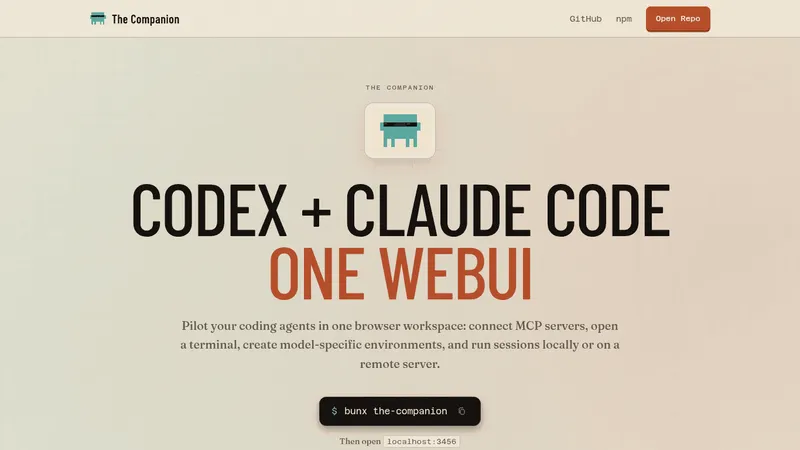
The Companion
thecompanion.sh- Good for
- Builders
- Category
- Development Tools
- Lets you
- Run several Claude Code and Codex sessions in one browser workspace
mastra.ai
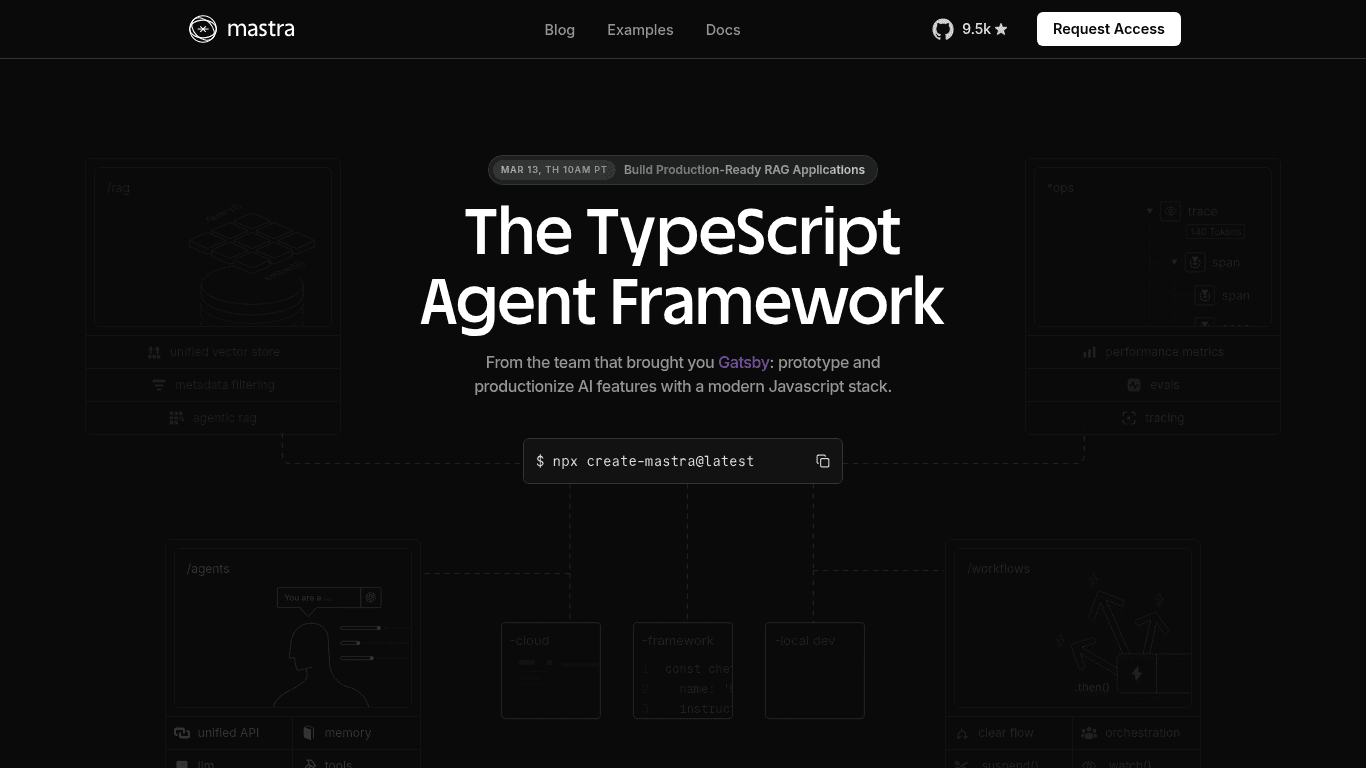
Mastra is an open-source TypeScript framework for building and deploying AI agents, workflows, and applications. It provides tools for agent creation, memory, tool calling, RAG, and evaluation within a JavaScript/TypeScript stack.
Visit website (opens in a new tab)Mastra is a modern framework designed to facilitate the creation and deployment of AI features utilizing a JavaScript/TypeScript stack. It aims to enhance the Developer Experience (DevX) for builders in the AI field, providing tools that streamline the process of developing AI agents and applications while integrating best practices from the TypeScript community.
Mastra has achieved considerable favor among developers, as indicated by numerous endorsements on social media platforms, highlighting various projects and innovations made with the framework. Many builders review Mastra positively, showcasing its effectiveness in simplifying the development process for AI agents.
Mastra provides a well-structured API that makes it easy to switch between AI providers with minimal code adjustments. It integrates various functionalities including:
const chefAgent = new Agent({
  name: 'Chef Agent',
  instructions: "You are Michel, a practical and experienced home chef who helps people cook great meals.",
  model: openai('gpt-4o-mini'),
  memory,
  workflow: { chefWorkflow }
});
.step() and .commit().testWorkflow
.step(llm)
.then(decider)
.then(agentOne)
.then(workflow)
.after(decider)
.then(agentTwo)
.then(workflow)
.commit();
Mastra incorporates memory mechanisms that allow agents to maintain both long-term and short-term memory. This ensures a robust recall of the context in which the agents operate, which is critical for more effective interactions and functionality.
Agents built on the Mastra framework can call functions, interact with other systems, and trigger real-world actions, making them versatile and utility-rich for various applications.
Mastra supports RAG capabilities that allow agents to access and query external data sources, enhancing their ability to provide accurate and relevant information based on real-time queries.
With built-in performance metrics and evaluation systems, Mastra enables developers to measure the accuracy, relevance, and efficiency of agents and workflows. Tracing capabilities incorporated into the framework further facilitate debugging and performance monitoring.
Mastra holds several key advantages for developers and teams:
Simplified Development: By providing a structured approach to AI development with clean semantics and intuitive interfaces, Mastra reduces the complexity often associated with building AI applications.
Robust Documentation and Community Support: Ongoing engagement from the TypeScript community ensures that developers have access to resources, examples, and support throughout their development experience.
Rapid Prototyping: The platform's flexibility enables swift iteration on prompts and agent functionalities within a local environment, empowering developers to experiment and refine their projects quickly.
Mastra is primarily targeted at:
AI Developers: These are individuals or teams focused on building AI agents and applications who will find Mastra's features beneficial in enhancing workflow efficiency.
TypeScript Enthusiasts: Developers already familiar with TypeScript will appreciate the framework's native support and inline integration that aligns with modern JavaScript practices.
Startups and Enterprises: Organizations aiming to implement AI functionalities in their products can leverage Mastra’s capabilities to deploy robust, scalable solutions that are easy to maintain and iterate upon.
Educators and Students: Those in academic settings can utilize Mastra for learning purposes, as it provides an engaging way to comprehend AI development principles using TypeScript.
The Mastra framework exemplifies a pivotal development in the AI landscape, offering a seamless integration between TypeScript programming and AI functionalities. By focusing on enhancing developer experiences and community contributions, Mastra positions itself as a valuable resource for builders, equipping them with the tools necessary to prototype and productionize AI features efficiently.
Ready to try it? Visit mastra.ai (opens in a new tab)