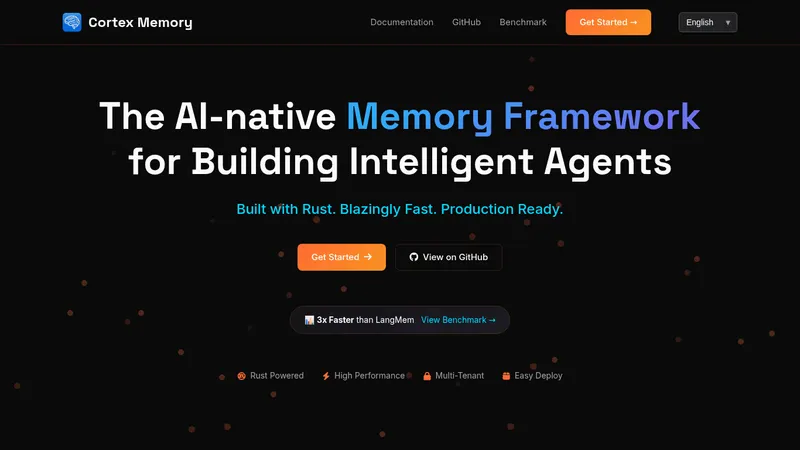
Cortex Memory
sopaco.github.io- Good for
- Builders
- Category
- AI Agents
- Lets you
- Give AI agents memory that persists across sessions

swarms.ai
Swarms is an open framework for building, deploying and scaling multi-agent AI systems, with orchestration patterns such as sequential workflows, parallel mixture of agents and hierarchical swarms. It is installed as a Python package and includes companion libraries for tools, models and memory.
Visit website (opens in a new tab)Swarms AI is an enterprise-grade framework designed to build, deploy, and scale autonomous AI agent swarms with notable control and efficiency. This multi-agent system empowers developers to orchestrate numerous AI agents simultaneously, thus enhancing productivity and performance across various industries.
To begin utilizing the Swarms AI framework, developers can easily install the toolkit with the command:
pip install -U swarms
Swarms AI boasts a thriving community, evidenced by 16,000+ members and 1.7 million downloads. Engaging with the community can provide support, inspiration, and shared knowledge among users.
Swarms AI offers diverse architectures to meet specific application needs, allowing users to create configurations that best fit their project requirements. Some of the notable architectures include:
The Swarms AI framework encompasses a broad range of features essential for modern AI applications:
Enterprise Architecture: Robust, production-ready infrastructure designed for reliability with features like modular design and comprehensive logging.
Agent Orchestration: Includes hierarchical swarms and dynamic rearrangements for optimal task handling.
Integration Capabilities: Flexibility through multi-model support, custom agent creation, and an extensive tool library.
Scalability: Designed to operate at scale with features like concurrent processing and load balancing for improved resource use.
Developer Tools: The framework provides a simple API, extensive documentation, and active community support, facilitating rapid development.
Security Features: Enterprise-grade security elements including error handling, rate limiting, and monitoring integration to ensure reliability.
Advanced Features: Incorporation of cutting-edge capabilities such as collaborative AI in group chat and centralized control.
Provider Support: Integrates with various service providers, making it vendor-independent.
Production Features: For robust environments, Swarms AI provides automatic retries and asynchronous support to enhance reliability.
Swarms AI is versatile and can optimize operations across various sectors, including:
The system exhibits a unique adaptability that makes it suitable for building tailored solutions to meet specific industry demands.
Swarms AI is complemented by a complete ecosystem of tools and libraries aimed at enhancing AI system development:
This expanding suite allows for extensive customization and efficient agent management, ultimately fostering innovative AI solutions.
Swarms AI stands as a powerful multi-agent framework, enabling organizations to harness the potential of AI through sophisticated agent orchestration. Its assortment of features, comprehensive integration capabilities, and strong community support make it an invaluable resource for developers and businesses looking to leverage AI in their operations. As industries continue to evolve, the demand for effective AI solutions underscores the importance of platforms like Swarms AI, setting the stage for the future of autonomous systems.
Ready to try it? Visit swarms.ai (opens in a new tab)