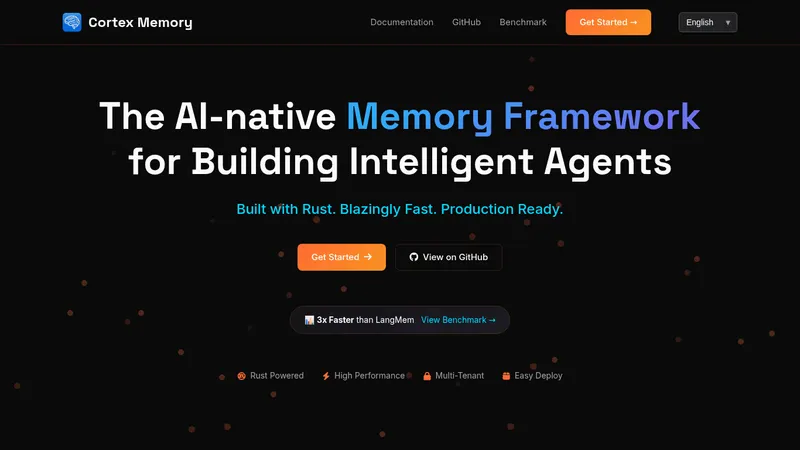
Cortex Memory
sopaco.github.io- Good for
- Builders
- Category
- AI Agents
- Lets you
- Give AI agents memory that persists across sessions
moonshotai.github.io
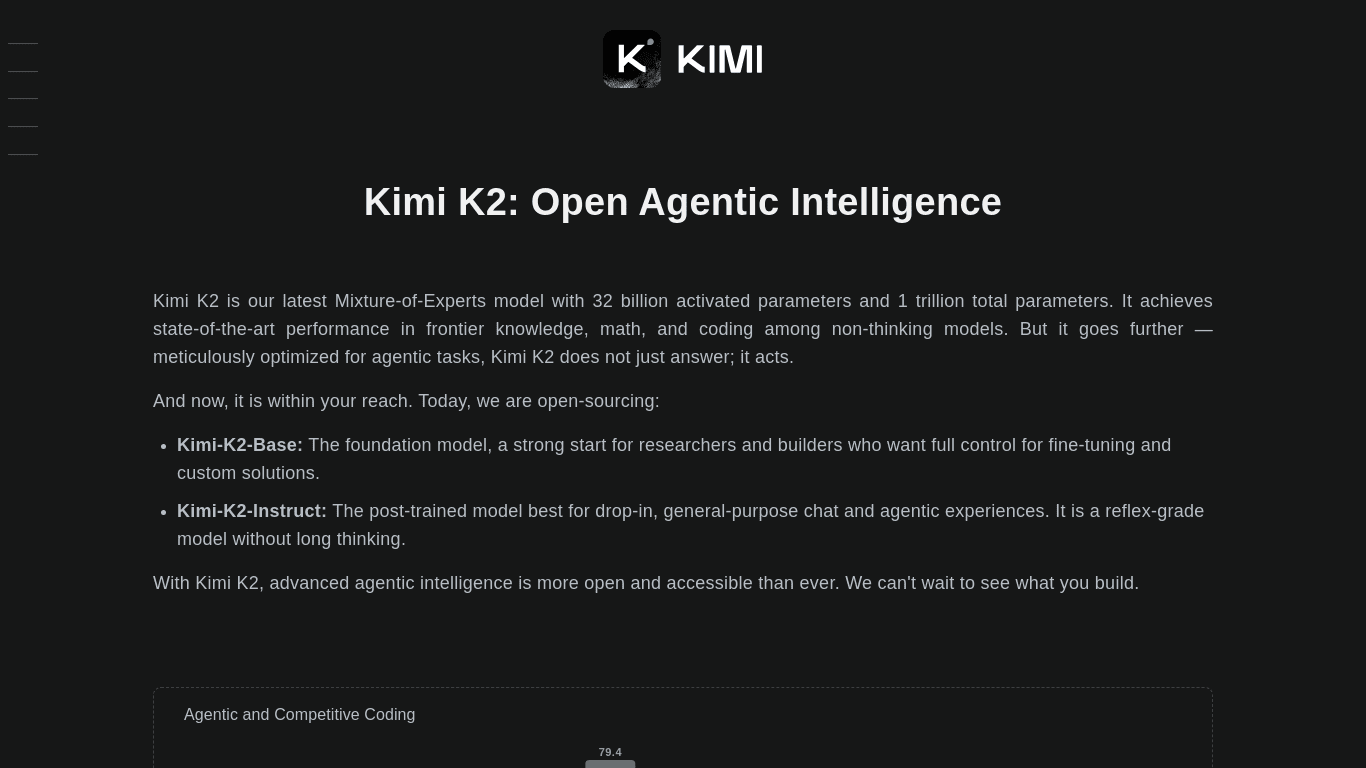
Kimi K2 is an open-weight Mixture-of-Experts language model with 1 trillion total parameters and 32 billion activated, optimized for agentic tasks such as tool use, coding and mathematics. It is offered in Base and Instruct versions with an OpenAI and Anthropic compatible API.
Visit website (opens in a new tab)Kimi K2 is an advanced Mixture-of-Experts model, boasting 32 billion activated parameters and 1 trillion total parameters. It demonstrates exceptional performance in areas such as knowledge retrieval, mathematics, and coding tasks. However, what sets Kimi K2 apart is its optimization for agentic tasks — not only does it provide answers, but it also acts upon them.
Kimi K2 offers two main model versions for users:
Kimi-K2-Base: This foundational model is ideal for researchers and developers aiming to have full control over fine-tuning and customization.
Kimi-K2-Instruct: Tailored for general-purpose interactions, this post-trained model excels in chat and agent-type exchanges with a swift response time.
With the open-sourcing of Kimi K2, advanced agentic intelligence is now more accessible than ever, enabling users to innovate with this versatile tool.
Kimi K2 has been rigorously evaluated across a variety of benchmarks to establish its competitive capabilities. Key benchmarks include:
Kimi K2 exhibits standout performance in coding, math, and STEM tasks, proving effective in automated coding scenarios, mathematical inquiries, and diverse coding languages.
Kimi K2 allows users to define tools and tasks without needing to configure complex workflows. Here are a few application examples:
Using a dataset spanning 2020 to 2025, Kimi K2 can analyze the impact of remote work ratios on salaries across varying experience levels (Entry, Mid, Senior, Expert). Key statistical findings from this analysis include:
The analysis further establishes the interaction effects of remote work on salaries based on experience levels, presenting a nuanced view of how remote employment can influence earnings.
Kimi K2 leverages a groundbreaking optimization technique known as MuonClip. This new optimizer enhances the token efficiency of training large language models (LLMs). Unlike conventional methods, MuonClip stabilizes training by controlling attention logits at their source, thereby preventing issues related to exploding attention logits.
Kimi K2 is trained with a comprehensive pipeline that creates high-quality agentic data through simulated tool-use scenarios. This approach is vital for developing the model's sophisticated tool-use abilities, enabling diverse application across varying tasks and industries.
Kimi K2 utilizes a general reinforcement learning (RL) strategy to improve its understanding and effectiveness in both verifiable and non-verifiable tasks. For example, it can objectively evaluate its outputs by functioning as its own critic, creating scalable feedback for complex tasks such as writing or coding.
Kimi K2 is readily available to users on both web and mobile platforms, free of charge. While the platform is still in development, it offers users the opportunity to explore its functionalities through the Researcher feature for agentic capabilities.
Developers can easily integrate Kimi K2 into existing applications through an OpenAI/Anthropic compatible interface. Instructional resources and deployment guidelines are accessible on GitHub for those interested in running Kimi K2 on various inference engines.
While Kimi K2 sets a strong foundation for open agentic intelligence, future iterations plan to incorporate enhanced capabilities, including advanced reasoning and a deeper understanding of visual contexts. Addressing current limitations — such as performance declines on complex tasks and potential truncations of output — remains a priority for ongoing developments.
Kimi K2 represents a significant leap in agentic intelligence, offering capabilities that extend far beyond typical language models. Its innovative architecture, high performance in complex tasks, and versatility make it an invaluable resource for researchers, developers, and businesses looking to harness the power of AI in mixed-use applications. The outlined statistics and use cases provide a compelling insight into how Kimi K2 can transform workflows and decision-making processes across various fields.
Kimi K2 is particularly useful for:
Kimi K2 unlocks the potential of AI-driven productivity, empowering users to explore and refine agentic tasks seamlessly.
Ready to try it? Visit moonshotai.github.io (opens in a new tab)